

Table of Contents
- Modern Cottage Style: Warm, Lived-In, and Layered
- Warm Neutrals and Earth Tones: Clay, Olive, and Plaster
- Curves and Sculptural Forms: Softening the Fifth Wall
- Moody Drenches and Sultry Color Palettes
- Organic Luxe Materials and Fluted Millwork
- Nostalgia and Personal Storytelling at Home
- Sustainable Home Decor 2026: Sourcing Eco-Conscious Pieces
- Best Practices for Home Styling in Small Spaces
- Frequently Asked Questions
Last Updated: September 11, 2026
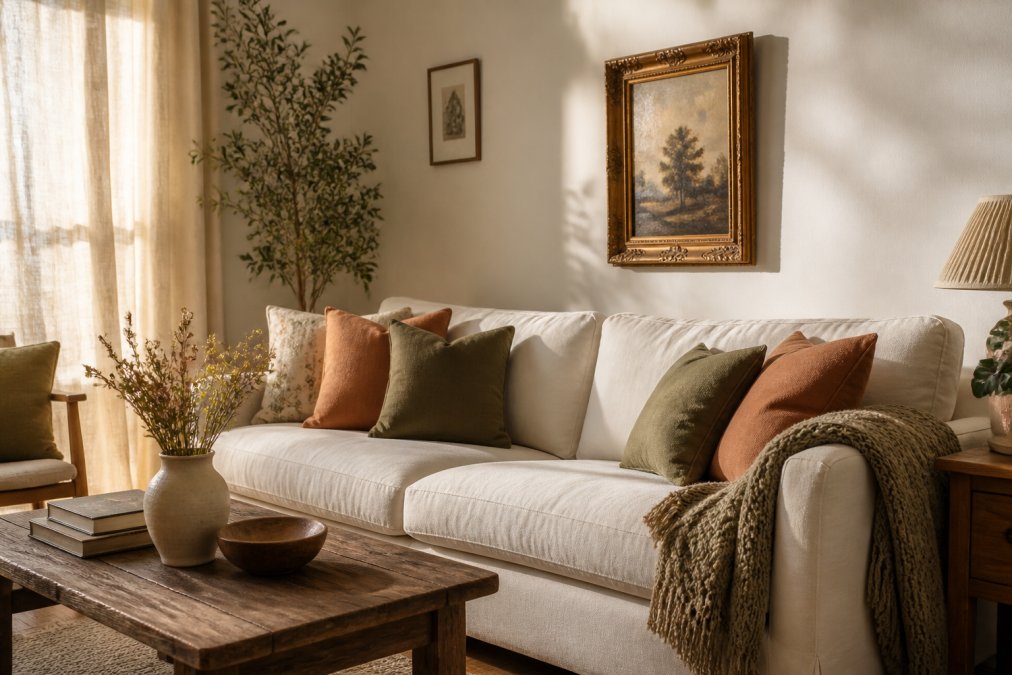
Modern Cottage Style: Warm, Lived-In, and Layered
The biggest shift in modern home decor trends 2026 is a move away from the stark and sterile toward rooms that feel genuinely lived in. Modern cottage style is the clearest expression of that: warm, layered, and forgiving of real life.
Modern cottage style pairs traditional coziness with clean modern lines, using natural textures, soft palettes, and collected rather than matching pieces.
Mixing Wood Tones Without the Mess
A common mistake is treating wood tones as a matching problem. Anchor one dominant tone and let two others play supporting roles, separated by a neutral textile.
- Dominant: the largest wood surface, such as a floor or dining table
- Secondary: a contrasting tone one step warmer or cooler
- Accent: a small piece, like a tray or frame, that ties the two together
Keep the finishes consistent even when the tones differ. Three glossy woods fight each other; three matte or oiled woods read as intentional.
Warm Neutrals and Earth Tones: Clay, Olive, and Plaster
Warm minimalism has replaced the cool gray palette of the last decade. Clay, olive, plaster, and bone are carrying modern interiors into 2026 because they flatter natural light.
The practical rule: pick one earth tone as your field color, a second as your secondary, and reserve a saturated accent for one surface only. A plaster-finish wall in soft clay reads calm; the same clay on every wall, sofa, and rug reads flat.
Textural contrast does the work color used to do. Pair a smooth plaster wall with a nubby wool throw and a woven jute rug, and the room gains depth without a single bold hue.
Curves and Sculptural Forms: Softening the Fifth Wall
Curved furniture is no longer a novelty. Rounded sofas, arched mirrors, and organic-shaped tables are now standard in modern home decor because they soften boxy rooms and break up hard lines.
The "fifth wall" is the ceiling. An arched floor lamp or curved pendant draws the eye upward and makes a low-ceilinged room feel taller.
One curved piece per room is usually enough. Two or three competing curves turn a considered space into a showroom.
Moody Drenches and Sultry Color Palettes
A color drench means painting walls, trim, ceiling, and sometimes doors in the same deep shade so the room reads as one enveloping volume. It is one of the year's defining looks.
Sultry palettes lean into deep olive, aubergine, charcoal, and oxblood. They work best in evening rooms like dining rooms and bedrooms, where low light flatters them.
The trade-off is real: drenched rooms need more light sources than pale ones. Layer a mix of overhead, table, and floor lighting, and use warm bulbs so the depth reads as cozy rather than cave-like.
Organic Luxe Materials and Fluted Millwork
Organic luxe pairs natural, tactile materials with a considered finish: honed stone, unlacquered brass, boucle, and raw linen.
Fluted and reeded millwork is the detail carrying this look through cabinetry, islands, and even furniture fronts. The vertical reeding adds shadow and rhythm without adding color, which is why it works in both moody and neutral rooms.
Where it falls short: fluted surfaces collect dust in the grooves. In kitchens and bathrooms, specify a finish that can be wiped down rather than a raw, unfinished wood.
Nostalgia and Personal Storytelling at Home
The most personal trend of the year is also the hardest to buy. Curated, collected rooms are outperforming showroom-perfect ones, so vintage frames, inherited pieces, and objects with a story are back at the center of modern home decor.
Storytelling at home means displaying objects for meaning rather than matching, what separates a styled room from a decorated one.
- One or two heritage pieces per room, not a full antique set
- Family photos in mismatched vintage frames rather than a uniform grid
- Objects you actually use, displayed where you use them
The test is simple. If you cannot explain why an object is in the room, it is clutter. If you can, it is character.
Sustainable Home Decor 2026: Sourcing Eco-Conscious Pieces
Sustainability has moved from a marketing line to a buying criterion, but the tag rarely tells you what you need to know. Sustainable home decor 2026 comes down to three questions: what is it made from, how was it finished, and can it be repaired?
The Three-Question Test
What is it made from? Reclaimed wood, recycled glass, natural fibers, and FSC-certified timber score well on the first question because the material already existed or came from a managed source. The Forest Stewardship Council's certification standards explain what the FSC label actually covers, so you can check a claim rather than trust it.
How was it finished? Low-VOC and water-based finishes matter for indoor air quality, which the U.S. Environmental Protection Agency's indoor air quality guidance covers in detail. A piece can be made from perfect material and still off-gas for weeks if the finish is wrong. Ask what was used on the surface, not just what is underneath it.
Can it be repaired? The question most buyers skip and the one that matters most over a decade. A sofa with replaceable covers, a table with a refinishable top, and a chair with a re-glueable frame all beat a sealed composite piece.
Certifications: What They Actually Cover
Textile certifications such as OEKO-TEX test for harmful substances, and the OEKO-TEX certification standards explain exactly what each label covers. The key distinction is between a certification that tests the finished product and one that only covers the raw fiber. Read the scope, not the logo.
A few practical rules for reading labels:
- Match the certification to the claim. A textile standard does not certify a wood finish, and a wood standard does not certify a fabric.
- Check the certificate number, not just the mark. Most certification bodies publish a lookup tool. If the number does not resolve, the claim is decorative.
- Treat "eco-friendly" and "green" as marketing language. Neither is a regulated term in home goods. Specific, verifiable claims name a standard and a body.
The Budget Reality
Eco-conscious sourcing has a reputation for being expensive, and sometimes it is. But the cheapest sustainability move is not a purchase at all, it is keeping what you already own. Refinishing a solid wood table, re-covering a chair, and repairing a lamp cord cost less than replacing the piece.
When you do buy, the highest-leverage categories are the ones you touch daily and keep longest: a sofa, a mattress, a dining table, a rug. The lowest-leverage categories are the ones you rotate seasonally, throw pillows, small decor, seasonal textiles.
Durability Is the Most Underrated Form of Sustainability
A sofa that lasts fifteen years beats three that last five, regardless of how the fabric was sourced. Three sofas means three times the material, shipping, and waste.
What durability looks like in practice:
- Upholstery: tight weave density, a rub count appropriate to the room, and covers you can remove and wash.
- Frames: solid wood or properly joined hardwood over particleboard, with corner blocks rather than staples alone.
- Finishes: oiled or water-based surfaces that can be touched up in place rather than factory-sealed veneers that cannot.
- Hardware: replaceable hinges, glides, and pulls, because hardware failure is what sends most functional furniture to the curb.
Best Practices for Home Styling in Small Spaces
Most 2026 trend coverage assumes you have square footage to spare. For many households the reality is the opposite: studios, one-bedrooms, and shared walls, where a trend only counts if it fits. Small-space styling is about making every piece work harder than its footprint.
The three moves that matter most are vertical storage, a visible floor plane, and furniture that does two jobs. A bench with lift-up storage beats a decorative console; a wall-mounted folding desk beats a writing table you walk around; a mirror opposite the main light source doubles daylight without adding a lamp.
Room-by-Room, With Real Constraints
- Studio living area: Anchor with one curved piece (an arched floor lamp or a rounded loveseat) rather than three. Curves read as intentional in tight rooms because they eliminate the sharp corners your eye trips over.
- Bedroom under 120 square feet: Skip the second nightstand. A wall-mounted shelf on one side and a slim floating drawer on the other keeps the floor clear and still gives both sleepers a surface.
- Rental kitchen: Fluted and reeded millwork is the trend most renters assume they cannot touch. Peel-and-stick reeded panels and adhesive fluted trim exist precisely for this, and they remove cleanly at move-out. Test a small section first, adhesion varies by wall finish, and a freshly painted wall can lift.
- Entryway: One heritage object, one hook rail, one tray. That is the whole system. Anything more and you have a pile, not an entry.
Smart Home Integration Without the Cable Sprawl
Smart home technology is the quiet advantage small spaces have been missing. The mechanism is consolidation: one smart plug replaces three timers and a power strip, and one compact speaker replaces a soundbar, a radio, and a charging dock. Fewer devices means fewer cords, and cords make a small room read as cramped.
A few practical rules:
- Choose one ecosystem and stay in it. Mixing three apps across five devices adds friction, not convenience, and friction is what makes people abandon the setup.
- Prefer devices that do more than one job. A smart bulb that dims and shifts warm is worth more in a small room than three fixed fixtures, because it changes the mood of the whole space from one outlet.
- Route power before you decorate. A single well-placed outlet strip behind a sofa or media unit hides the entire system. Adding outlets later means moving furniture.
- Keep audio portable where the room is multi-use. A speaker rated for outdoor use can move between a balcony and a living space, which means one purchase covers two zones. A speaker rated for outdoor use can move between a balcony and a living space, which means one purchase covers two zones.
The Small-Space Decision Table
| Small-Space Problem | Fix | Why It Works |
|---|---|---|
| Low ceiling | Arched lamp or curved pendant | Draws the eye upward and breaks the flat plane |
| No floor space | Wall-mounted or lift-up storage | Frees the floor plane entirely |
| One light source | Mirror plus two layered lamps | Doubles light and adds warmth at night |
| Cable clutter | One smart plug, one speaker | Fewer devices, fewer cords, one app |
| Rental walls | Peel-and-stick reeded panels | Trend-level detail with clean removal |
| Feels generic | One heritage object | Adds story, not bulk |
| Multi-use room | Portable speaker | One purchase covers indoor and outdoor |
How to choose durable home decor in a small space comes down to the same materials test as anywhere else, with one addition: measure the doorway and stairwell before you fall in love with a sofa. Look for tight weave density, solid or properly joined frames over particleboard, and finishes that can be touched up rather than replaced. Machine-washable covers matter even more in a small room.
Frequently Asked Questions
What are the biggest modern home decor trends for 2026?
Warm neutrals in clay and olive, sculptural curves, moody drenches, fluted millwork, and organic luxe materials lead the list. Modern cottage styling and personal storytelling through vintage frames and heritage pieces are also strong. Sustainable home decor 2026 favors reclaimed wood and OEKO-TEX certified textiles, while small-space styling leans on reflective accents and multi-use furniture.
Are minimalist designs still relevant for 2026 home decor?
Yes, but the look has shifted from cold and sparse to warm minimalism. Think plaster walls, wood tones, and textural layers instead of stark white rooms. Fewer pieces, but each one earns its place through material quality and function. This approach pairs well with how to choose durable home decor: buy less, choose better, and let the pieces carry the room.
What color palettes are trending for modern homes in 2026?
Earth tones dominate: clay, olive, ochre, mushroom, and warm plaster whites. Moody drenches in deep green, chocolate brown, and sultry plum are showing up on all four walls plus trim and ceiling. For contrast, designers pair these with reflective accents like unlacquered brass or polished stone to keep the depth from feeling heavy.
How can I mix vintage and modern decor in 2026?
Start with a modern base, then layer in one or two heritage pieces: a vintage frame, a reclaimed wood console, or a sculptural lamp from a flea market. Keep the palette tight so the eras read as curated rather than cluttered. The best practices for home styling say limit each shelf to three objects and vary height, texture, and material so the mix feels intentional.